
The following executive dashboard design examples provide illustrations of how organizations can benefit from a predictive performance measurement system so that more informed decisions can be made from their business dashboard.
An actual executive dashboard will later be used (with permission) to illustrate how a management dashboard can be enhanced so that business intelligence tools insight is gained without detailed analytics. One might consider this form of dashboard design to be a type of business intelligence dashboard or BI dashboard, which is easy to understand. From this understanding, the most appropriate action or non-action can then be taken.
Executive Dashboard Design Examples – Current State
An executive management dashboard reporting is presented in a company using the following executive dashboard template format:

From this common-format for an executive dashboard template one can note that there are four products. I will now enlarge the first entries of Product A so that the names of the categories can be easily read.
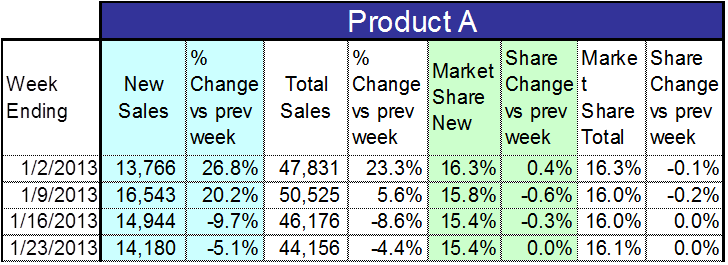
My observations for each of these four product category report-outs are:
- Much emphasis is given to comparing one week to the next in these executive dashboard design examples. Is this a good thing to do? Often this form of comparison is given in dashboard reporting; however, the observed week-to-week changes can be the result of normal process variation and result in misunderstandings about whether the report-out in fact had a statistical change or not. Later I will be addressing this point when the data are presented differently.
- There is no mention of profitability in the above dashboard template for key performance indicators dashboards (KPI dashboards) reporting. The sales function could gain more sales through deep discounts to make these reported numbers look better. Price reduction efforts resulting from this form of management dashboard reporting, could even lead to the corporation’s losing money for the entire product line. This practice would obviously not be good for the business; however, this executive business dashboard does not discourage the use of this practice. Some measures that reflect profitability should be considered for this executive dashboard design example.
- Sales and other costs are not addressed in this executive dashboard reporting. Executive business dashboard reporting can gain much if they consider theory of constraint (TOC) metrics when developing their KPIs.
- The format of this executive dashboard does not encourage process improvement efforts. The output of a process is a function of its inputs and process steps. If an enhancement is desired in the process output, the inputs or process steps need to be improved.
- Focus is given to “new sales.” I am sure what this executive dashboard design entry means; however, if this entails the capturing of new customers, then there could be a loss of focus to the maintenance of existing customers, which is not a good thing.
Executive Dashboard Design Examples – 30,000-foot-level Predictive Performance Metric Reporting
The data from these executive dashboard design examples will next be used to show an alternative reporting format. The following described 30,000-foot-level reporting methodology provides predictive measures, where if one does not like what one expects to occur in the future, something needs to be done to the fundamental process or its inputs. An organization can manually create these charts or have automatically generated report-outs of these 30,000-foot-level metrics through use of Enterprise Performance Reporting System (EPRS) dashboard software.
With 30,000-foot-level reporting:
- The common-cause variability of a process is separated from special-cause variability. If a process has common-cause variability and the response is not desirable, one needs to enhance the process. This form of thinking discourages the examination of differences between adjacent time periods, as was done in the current dashboard reporting shown initially.
- Processes are examined for stability at the 30,000-foot-level. If a process has a region of stability and then shifts to a different level of performance, the regions of stability would be staged to illustrate this.
- If a process has a recent region of stability, the process can be said to be predictable. The data from the recent region can be considered a random same of the future and used to formulate a predictive statement as part of the 30,000-foot-level dashboard reporting.
For the executive dashboard design examples previous shown, the following illustrations will be given for the total sales for all products and individual products; however, the concepts could be applied equally well to the other metrics such as new sales and market share.
Executive Dashboard Design Examples – Total Sales of All Products
In the above dashboard design reporting, no mention was made of total sales. One would think that executives would be interested in this metric. A 30,000-foot-level management dashboard for total sales of all products would be:
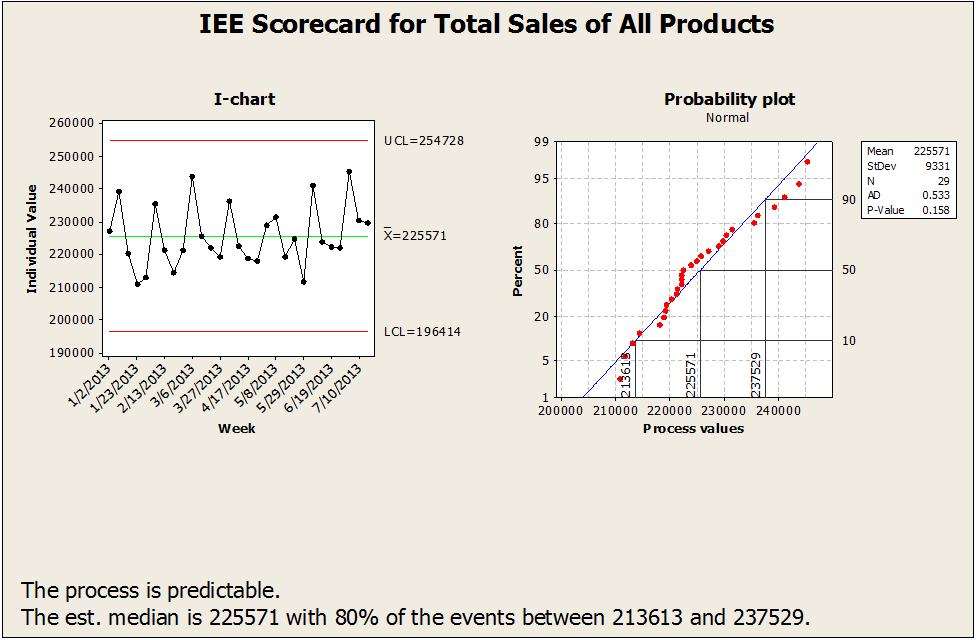
This 30,000-foot-level report-out of total sales for all products can be considered to have three regions: test for process stability, prediction statement determination if appropriate, summarizing how the process is performing in words that everyone can understand:
1. Test for process stability: The first thing in the report-out to examine is the individuals chart on the left. The upper control limit (UCL) and lower control limit (LCL) are statistically determined because of the inherent variability of the process. If there are no trends relative to these lines or values beyond the lines, then one can say that the process is stable. For this set of data we can say that the corporate week-to-week response for total sales of all products is stable. From an overall point of view, nothing has changed.
2. Prediction statement determination if appropriate: For continuous data like the above, a probability plot provides a very good means for determining a prediction statement. Initially this plot might look intimidating, but it is quite simple to understand with a little explanation. The horizontal axis for this probability plot is simply the process-output response (vertical axis of the individuals plot). The vertical axis is percent less than. Since there is no specification for this metric, a median and 80 frequency of occurrence can be reported. The 90 – 10 on the vertical axis of the probability plot provides the 80% frequency of occurrence.
3. Summarizing how the process is performing in words that everyone can understand: At the bottom of the chart pair above the determined median and 80% frequency of occurrence are reported for this stable, predictable process.
From the initial table of numbers dashboard design report that was shown above, I am not sure if executive management thought improvements or changes occurred; however, the above 30,000-foot-level dashboard reporting indicates that from an overall point of view no changes occurred.
Executive Dashboard Design Examples – Total Sales Product A
A 30,000-foot-level dashboard reporting for Product A is:
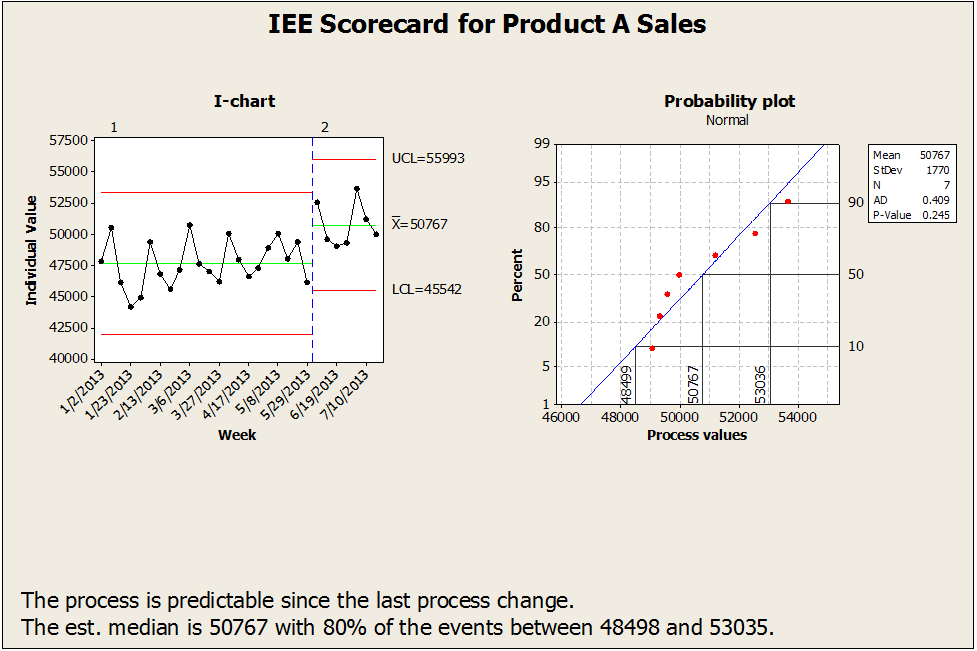
This 30,000-foot-level business intelligence dashboard provides additional insight into this metric. It would seem from the initial table of numbers business dashboard that it would have been difficult to determine how the process output response changed about 5/29/2013. This 30,000-foot-level executive dashboard template provides insight to this change and what could be expected in the future unless something were done differently.
Executive Dashboard Design Examples – Total Sales Product B
A 30,000-foot-level dashboard reporting for Product B is:
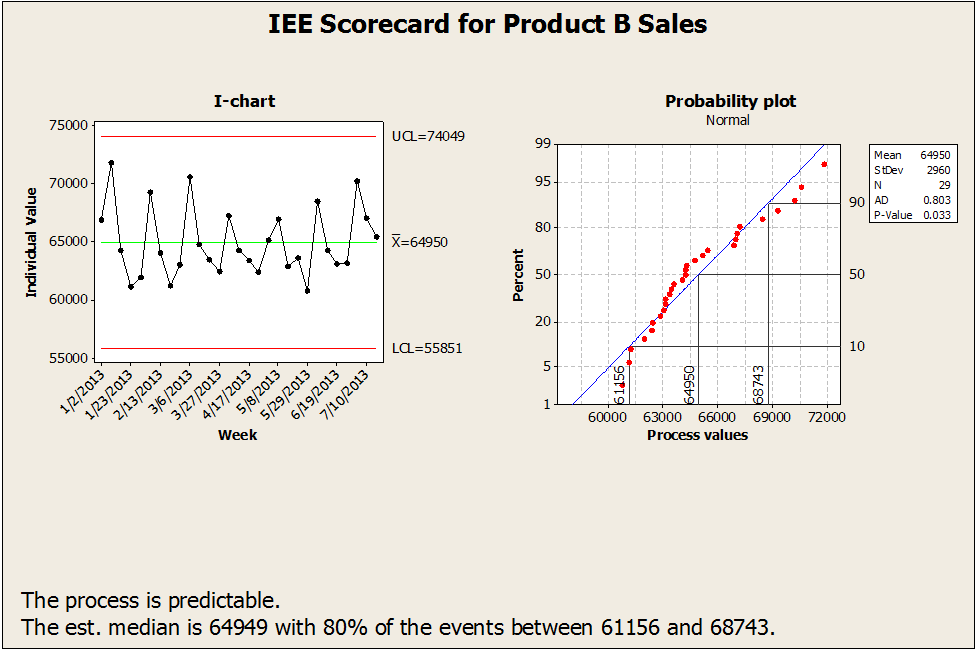
From this executive dashboard template format, it is observed that there are no trends relative to the UCL and LCL limits, which were calculated from the variability of the process. Because of this, it is concluded that the process is stable and a prediction statement can be made from the use of all the data from the period of time shown. One should note that with 30,000-foot-level dashboard reporting one is not bounded by calendar year when making prediction statements.
Executive Dashboard Design Examples – Total Sales Product C
A 30,000-foot-level dashboard reporting for Product C is:
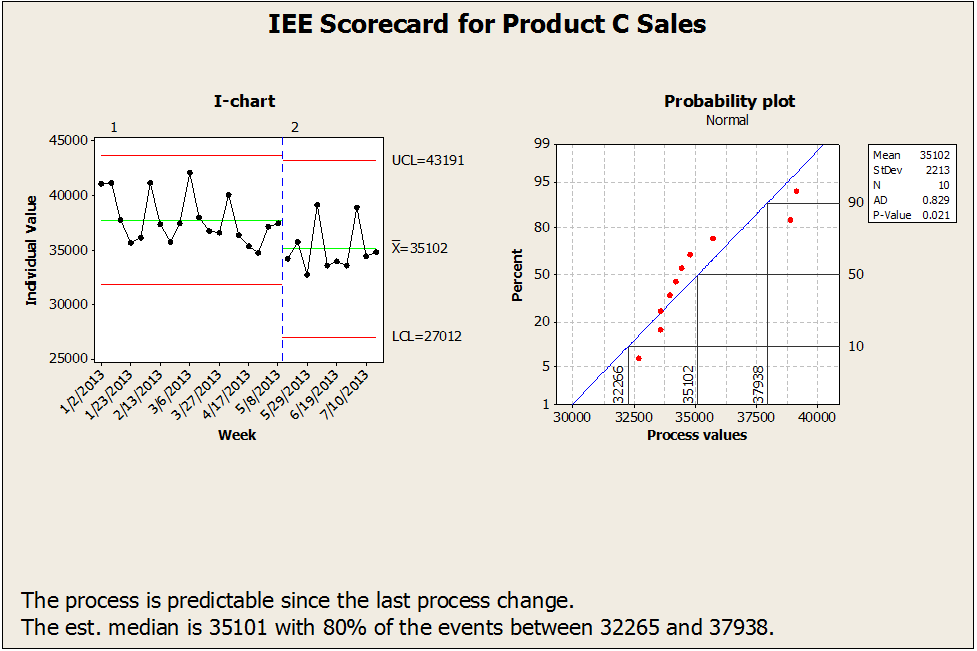
From this 30,000-foot-level management dashboard report, one could conclude the amount of sales for product C declined since there was a trend relative to the initial UCL and LCL limits. The data from the recent region of stability are now used to provide a predictive business dashboard statement.
Executive Dashboard Design Examples – Total Sales Product D
A 30,000-foot-level dashboard reporting for Product D is:

From this form of KPI dashboards reporting, one could conclude that sales for product D increased from a process point of view about 3/6/2013. Like conclusions from the other 30,000-foot-level management dashboard presentations, it would have been very difficult, if not impossible to make this observation from the initially presented executive dashboard presentation of a table of numbers.
Executive Dashboard Design Examples – Summary
From the above 30,000-foot-level dashboard reporting, one can conclude that overall total sales did not change over the observed time period; however, two products indicated an increase in sales while one product’s sales declined. It is highly unlikely that one would make this conclusion from the table of numbers.
The use of 30,000-foot-level performance dashboard reporting can provide a business intelligence dashboard, which can prove to be very valuable in helping managers at all levels improve the decisions that they make.
Other KPI dashboard example conversions to predictive reporting illustrations are described in the article Transitioning Dashboards to Predictive Reporting Examples.
Executive Dashboards – Avoid Attempting the “Management” of Process Outputs
Organizations often set goals for executive dashboard metrics. This is not a bad thing; however, if a process has common-cause variability, as was noted above, then emphasis to achieve the goal should be given to determine and execute what might be done in the process to improve its performance so that the dashboard reporting indicates at a 30,000-foot-level of performance that a change has been made to the positive. If this effort is not undertaken, then what can result is playing games with the numbers to make things look better than they are. Game playing can lead to unhealthy, if not destructive, organizational behaviors.
Executive Dashboards – Automatic Report-outs and Big Picture Financial Enhancements
An Integrated Enterprise Excellence (IEE) value chain can be useful to determine business dashboards metrics and then align the management dashboard reporting to the processes that create the metrics. The IEE system can then be used to determine which metrics need improvement so that the enterprise as a whole benefits.
The IEE value chain can have automatic dashboard reporting updates using the EPRS dashboard software system.
Next Steps: Creation of an Effective 30,000-foot-level Business Dashboard
If you believe that your organization could benefit from the concepts that were illustrated in the above executive dashboard design examples, work with me to create at no charge an evaluation of one or more of your current dashboard reporting metrics. This assessment would be similar to that shown above, from which you and your organization could have much benefit. My contact information is Forrest@smartersolutions.com and +1.512.918.0280.
Thanks for this example Forrest – I see this type of data frequently. It provides little information in the form that it’s in but I see several of the large consulting houses building these types of grids for clients – of filling the cells with red, yellow, and green (then they ask me what they mean!). Rather than deciding what questions should be answered and finding data to answer it, business people often look at what data they have available or can get from vendors and try to see what it tells them. Of course, if they never look at it with a 30K foot view they see very little and can make some bad decisions.
E. J. agree with your points. One thing that you might find useful is to take a situation and present the data in a 30,000-foot-level format so that they can compare the two data-presentation formats to see the benefits of the predictive performance metric reporting methodology.